
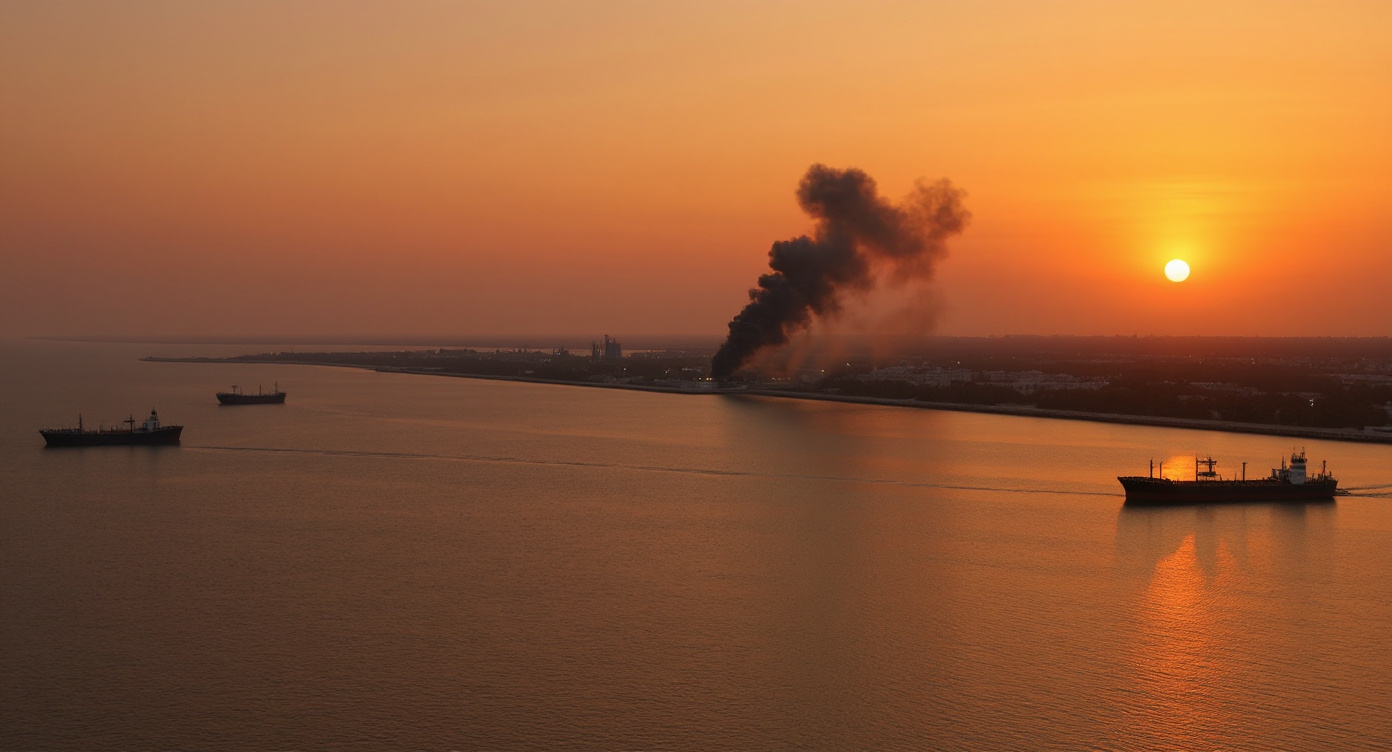
Three merchant ships hit in the Strait of Hormuz on Saturday. One of them — the Qatari LNG carrier Al Rekayyat — caught fire near Limah, Oman. A second oil tanker took a strike on its port side near the Omani-Emirati border. A third was hit by a drone off the Omani coast.
By the time Iran's Islamic Revolutionary Guard Corps finished trying to take out ships, U.S. Central Command had already drawn up the target list.
The U.S. military struck more than 80 Iranian targets in response, hitting air defense systems, coastal surveillance installations, ground-to-air missile batteries, anti-ship cruise missile launch sites, drone launch facilities, and port infrastructure at Qeshm and Bandar Abbas. CENTCOM said the strikes were designed "to impose heavy costs for targeting and attacking commercial shipping crewed by innocent civilians in an international waterway."
The Strait of Hormuz carries roughly one-fifth of all globally traded oil and natural gas. Last weekend, 108 ships transited the strait using various routes — some deliberately avoiding Iran-approved shipping lanes. When Iran decides to start shooting at tankers in that corridor, it's not a regional dustup. It's a direct threat to the global economy.
President Trump, attending a NATO summit in Turkey during the strikes, didn't hesitate. The administration revoked Iran's oil sale license — a conditional incentive that had authorized Iranian oil production and delivery through August 21 as part of ongoing negotiations toward a permanent deal. That carrot is gone now.
Vice President JD Vance had previously said that talks with Iranian officials "created a good foundation for a successful final deal." Iran's response to that foundation was to fire on commercial shipping and provoke a naval confrontation.
Iran's Deputy Foreign Minister Kazem Gharibabadi claimed on X that the strikes violated the interim agreement. The Iranian Foreign Ministry issued a formal statement warning that "the U.S. government bears responsibility for the consequences of this breach of commitment." Qatar's Foreign Ministry spokesperson Majed Al-Ansari was less sympathetic to Tehran, calling the tanker attack "unacceptable" and holding Iran "fully legally responsible" for what he described as an assault on international navigation and energy security.
The timing is notable. The strikes came as hundreds of thousands of mourners gathered in Tehran for the funeral procession of Ayatollah Ali Khamenei, Iran's 86-year-old Supreme Leader who was killed at the war's outset on February 28. His son, Ayatollah Mojtaba Khamenei, reportedly assumed the title of Supreme Leader but has been wounded and is in hiding. The body was scheduled to arrive in Najaf, Iraq on Tuesday, with burial planned at the Imam Reza shrine in Mashhad on Thursday.
Iran's leadership is fractured, its supreme leader is dead, his successor is hiding, and the IRGC's strategic assets at Qeshm and Bandar Abbas are smoking. The interim agreement offered Iran a 60-day window of charge-free passage and a path to normalized oil sales. Instead of taking the deal, they shot at tankers and drew fire on their own port facilities.
But President Trump isn't satisfied even after striking Iran, he told a crowd he has more plans for Iran the day after the strikes.
The previous administration's approach to Iranian aggression involved careful statements, back-channel diplomacy, and strategic patience — which in practice meant absorbing provocations and hoping the next one wouldn't be worse. That math never worked. It just taught Iran that escalation carried no price.
Eighty targets in one round. Oil license revoked. Port infrastructure flattened. Iran had a deal on the table and lit it on fire. Now the table's gone too.