
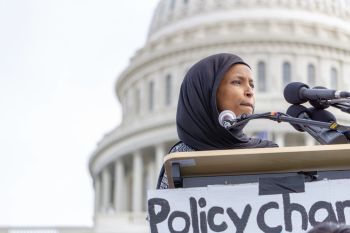
The BDS movement has been the progressive left's defining cause on Israel — Rashida Tlaib, Ilhan Omar, Alexandria Ocasio-Cortez and others have spent years pushing it. On Wednesday, 33 of their Democratic colleagues voted to strip federal funding from any college that participates in it.
That was a repudiation from within. And it wasn't close.
H.R. 4795, the Protect Economic and Academic Freedom Act of 2026, passed 237–169. Sponsored by Rep. Virginia Foxx of North Carolina, with Democratic co-sponsor Rep. Josh Gottheimer, the bill requires any college participating in federal student-aid programs to certify it is not engaged in boycotts of Israel. Schools that refuse lose access to certain federal higher-education funds.
Two hundred and three Republicans voted yes. Thirty-three Democrats and one independent joined them. One hundred and sixty-seven Democrats voted no. Twenty-seven members didn't vote at all.
House Minority Leader Hakeem Jeffries, Minority Whip Katherine Clark, and Democratic Caucus Chairman Pete Aguilar all voted no. Leadership took a public position and a sixth of their caucus ignored it. They whipped against this bill and still lost 33 votes.
The names on the yes side aren't backbenchers nobody's heard of. Reps. Jared Moskowitz, Brad Schneider, Ritchie Torres, Laura Gillen, George Latimer, Vicente Gonzalez, Jared Golden, Marie Gluesenkamp Perez, and Eugene Vindman all voted yes. Several represent swing districts where standing with the Squad on Israel boycotts is political poison. These were deliberate votes, not accidents.
Gottheimer explained his position plainly: "The BDS movement has no place on college campuses, particularly while Jewish students face threats." Rep. Foxx was equally direct: "Taxpayers should not be forced to subsidize institutions that discriminate."
Rep. Jerry Nadler of New York voted against the bill while insisting he opposes BDS — explaining he will "always defend Americans' First Amendment right." A creative way to vote with the boycott crowd while claiming he's not really with the boycott crowd.
Republicans weren't entirely unified. Reps. Thomas Massie of Kentucky and Warren Davidson of Ohio voted no on free-speech grounds from the libertarian end of the spectrum. Two dissenters on one side versus thirty-three on the other tells you which coalition is holding together and which one isn't.
The vote happened at 10:24 a.m. Eastern on September 3, Roll Call Number 295. It marks one of the largest Democratic defections on a Republican-led bill this Congress — a number that rules out protest votes and one-offs. A third of the Democratic caucus did the math and decided their leadership was on the wrong side of it.
The bill now moves to the Senate, where the math gets trickier but the political dynamics stay the same. Democrats in competitive states or with significant Jewish constituencies will face the exact same choice their House colleagues just made. Thirty-three of those colleagues just showed them which way the wind is blowing.
When your own party can't hold the line on a vote they publicly whipped against, the problem isn't the bill. The problem is the coalition.