
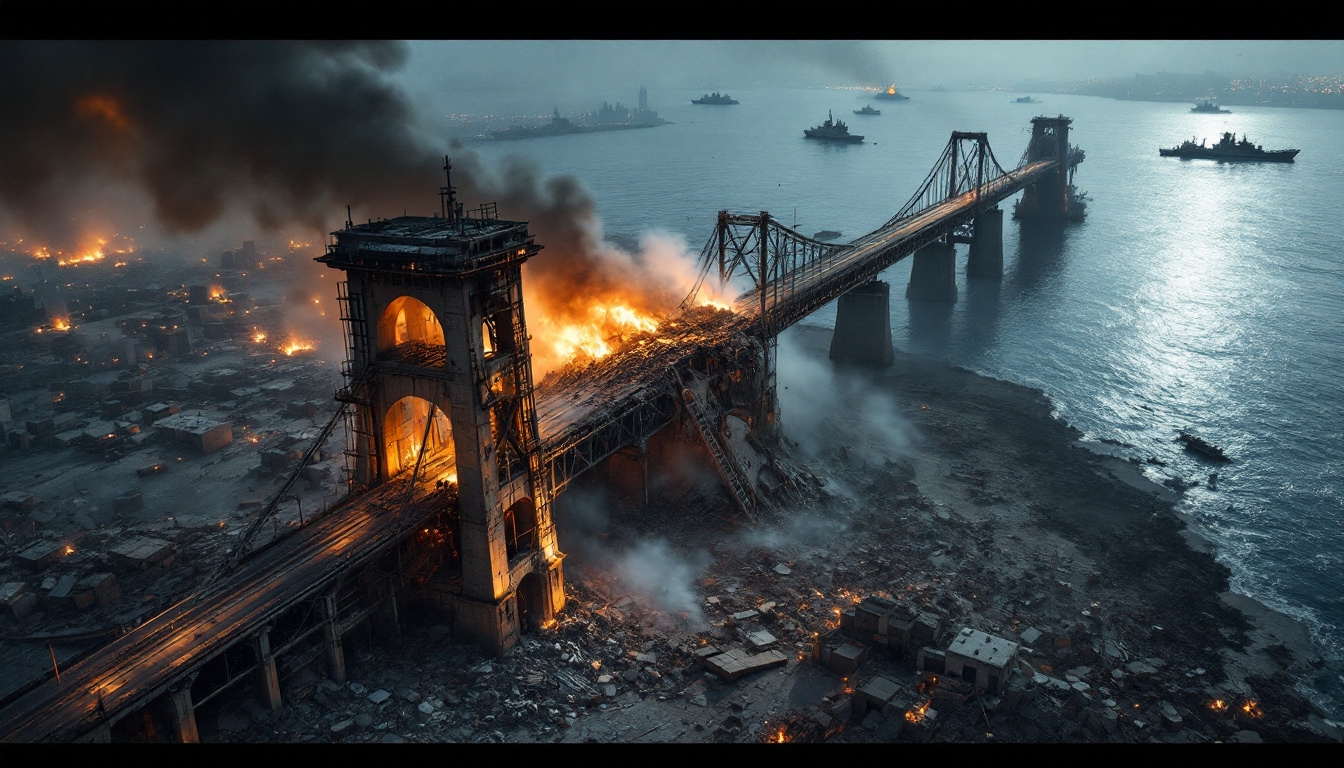
A surveillance tower overlooking commercial traffic at Iran's Chabahar port is now rubble. Bridges, railways, and highways in Hormozgan province are gone. Bandar Abbas — a city of 500,000 on the Strait of Hormuz and the headquarters of Iran's navy — is being cut off from the rest of the country. At least seven people are dead, according to Iranian state television, after the United States launched its sixth consecutive night of airstrikes on Friday, July 17th — hitting dozens of targets across southern Iran including the port city of Bandar Khamir.
Iran's response was to fire missiles at three U.S. partner bases in Bahrain, Kuwait, and Qatar. Falling debris in Qatar wounded a child.
Let's be clear about the arithmetic here. The U.S. controls the Strait of Hormuz — the chokepoint through which roughly one-fifth of the world's oil and natural gas trade flows during peacetime. Weekly cargo shipments through the strait have already dropped nearly 25% since the conflict escalated. The American naval blockade on Iranian ports is back in force. Washington has redirected three commercial vessels, disabled one, and boarded another.
Iran's entire economic leverage depends on threatening to close that strait. Six nights of precision strikes on the very infrastructure Iran uses to monitor and control port traffic tells you exactly how much that leverage is worth right now.
President Trump put it plainly: "We are likewise winning big in Iran, and you will see the fruits of that labor very, very shortly."
Defense Secretary Pete Hegseth oversaw the latest round of targeting, which expanded beyond military installations to include bridges, railways, highways, and port infrastructure Tehran relies on to project power in the Gulf of Oman. "Iran does not control the SoH," Hegseth posted Friday alongside images of the destruction. Chabahar port, which operates with Indian support, is one of Iran's few deepwater facilities outside the Persian Gulf proper — and its surveillance tower is now a pile of concrete. Iran's Energy Ministry, meanwhile, urged citizens to reduce electricity consumption after strikes damaged power facilities — a sign the campaign is reaching beyond military targets into Iran's domestic infrastructure.
The war, which began on February 28 between the U.S., Israel, and Iran, saw a brief interim ceasefire that collapsed after lasting just one month. Since then, the escalation has been one-directional. Iran fires missiles at bases in allied countries. The U.S. systematically dismantles Iranian infrastructure. One side is degrading the other's capacity to fight. The other side is wounding children with debris.
Tehran's strategy — if you can call it that — appears to be hoping that striking U.S. partner nations will fracture the coalition. But when your missile barrages produce one injured child in Qatar and some property damage in Kuwait, while the other side is collapsing your port towers and cutting your bridge networks, you're not projecting strength. You're demonstrating the gap.
As the Associated Press's Jon Gambrell reported from the region, the strikes hit Hormozgan province targets across multiple categories — surveillance, transportation, and port operations. This isn't random bombing. It's infrastructure denial, methodical and sequential, designed to make Iran's southern coast operationally useless.
Six nights. Bridges down. Tower collapsed. Naval blockade enforced. Cargo shipments cratering.
Iran's one card was the Strait of Hormuz. The hand's being played for them.