
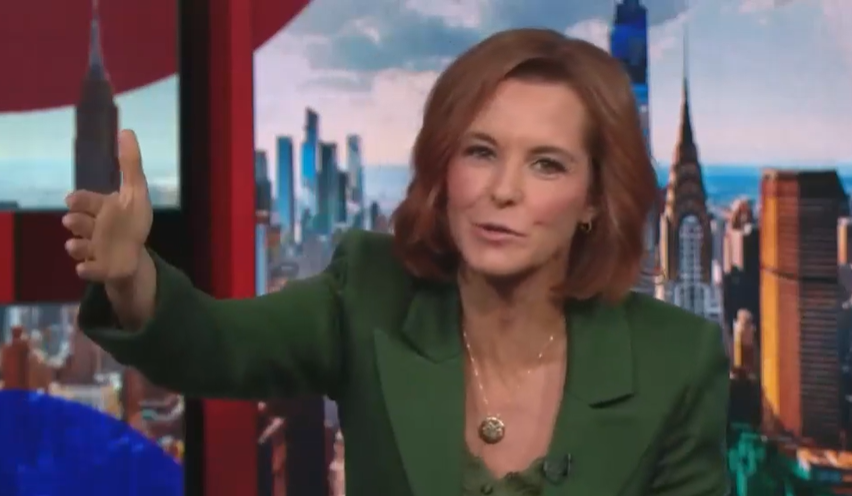
MSNBC interrupted President Trump's United Nations General Assembly address to deliver a live fact-check. Then they got the fact-check wrong. Then they had to issue an on-air correction to their own correction.
That's three layers of failure on a world stage, for anyone keeping count.
Stephanie Ruhle, host of MS NOW on MSNBC, cut into the President's speech to dispute his claim about ending "eight wars." The problem wasn't that she interrupted — networks do that. The problem was that the information she used to contradict the President was itself incorrect, forcing the network into the uniquely humiliating position of walking back its own real-time challenge while the speech was still making news.
Fox News correspondent Trace Gallagher captured the absurdity without breaking a sweat. "Allowing MS to fact-check the president is like allowing the United Nations to fact-check Israel," Gallagher said. He added the obvious: "The whole thing is you want to criticize the president and then you screw up the criticism."
He wasn't wrong. A fact-check only works if it's, you know, factual. The entire value proposition of interrupting a sitting president's address to a global body is that the network has better information than the man at the podium. When it turns out the man at the podium was closer to right than the control room, what you've actually broadcast is a credibility crisis with your own logo in the corner.
Shirin Yadegar, a contributor to LA Mom Magazine and panelist on the segment, drew a sharper line. "If you're going to interrupt the president for fact-checking, then make sure you're going to do it across the board," she said. Then came the verdict: "This is activism. This is not journalism."
That distinction matters because MSNBC doesn't frame itself as activism. It frames itself as news. The fact-check format borrows authority from journalism — the chyron, the tweedy seriousness, the implication that someone in the building checked the numbers. When the numbers are wrong, the borrowed authority collapses, and what's left is exactly what Yadegar called it.
Panelist Jeff Vaughn offered what sounded like a concession but landed as an indictment: "I'm okay with them fact-checking, but it seems like they wanna interrupt and get the last word." The goal wasn't accuracy. The goal was the interruption itself — the visual of a network stepping on a president's words in real time. The fact-check was the vehicle, not the point.
This wasn't a case of a borderline claim getting a contested rating. MSNBC's correction was unambiguous — they got it wrong and had to say so on air. That's the kind of error that doesn't get memory-holed by the next news cycle because the clip exists, the correction exists, and the contrast between the confidence of the interruption and the embarrassment of the walkback is the whole story.
Gallagher said "the Fox News Common Sense department was not one bit surprised." Neither was anyone who's watched this pattern repeat since 2016: interrupt, assert, get corrected, move on, hope nobody clips it.
Somebody clipped it.