
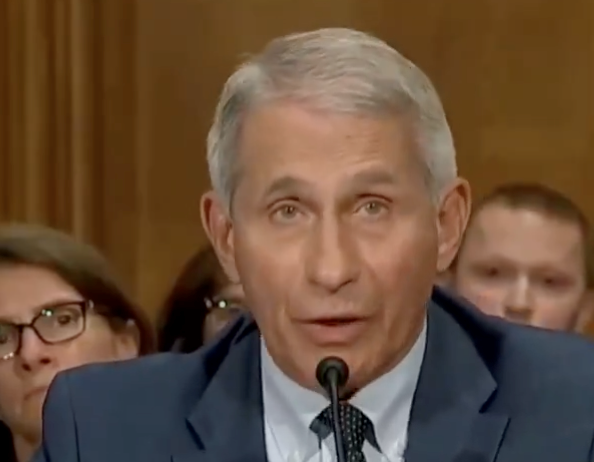
Anthony Fauci kept a diary. One thousand, one hundred and forty-one pages of it. Senator Rand Paul (R-KY) published the whole thing, and the word "award" appears 80 times. "Hero" shows up 49 times. "Instagram" gets 36 mentions. "Selfie" clocks in at 19.
The phrase "learning loss" appears zero times.
The diaries — released through the Senate Homeland Security and Governmental Affairs Committee — read less like the private reflections of a public health official managing a global pandemic and more like the green room journal of a man who confused a crisis with a casting call. By March 22, 2020, Fauci was writing, "Press is going wild with me. Front page in Washington Post yesterday." Two months later, on May 21, 2020, the entry got even more clarifying: "I am the most famous and talked about person in the country."
That's not a scientist processing data. That's a brand manager tracking impressions.
But the diary entries about fame aren't even the worst of it. The diaries and accompanying communications reveal that prominent journalists weren't just covering Fauci. They were texting him, coaching him, and running interference against his political opponents.
Jake Tapper, CNN's self-appointed hall monitor of journalistic integrity, texted Fauci in April 2020: "Hard to believe Laura Ingraham went to Dartmouth, isn't it." That's not a reporter contacting a source. That's a colleague bonding over a shared enemy. And it got worse — by July 2020, Fauci was feeding Tapper questions to use in an interview with then-Assistant Secretary for Health Brett Giroir, a man Fauci privately described as "talking bullshit about testing."
A federal health official was scripting CNN interviews to undermine a colleague inside the administration. Tapper used them.
Then there's Dana Bash, CNN anchor and current host of State of the Union. After Fauci's contentious April 2021 exchange with Congressman Jim Jordan (R-OH), Bash texted Fauci directly: "I just watched the whole Jordan thing. Again, you're a better man than I." She followed up: "No one would have blamed you if you said simply 'Mr. Jordan, go f— yourself.'"
This is the same Dana Bash who continues to interview Fauci on her program as though she's conducting journalism rather than continuing a personal friendship. The texts don't suggest bias. They confirm it, in writing, with timestamps.
The Washington Post's Michael Gerson wrote a column on April 5, 2021 that Fauci noted approvingly in his diary. The New York Times' Maureen Dowd, The Atlantic's Peter Nicholas, CNN's Wolf Blitzer — they all appear in the diaries not as adversaries asking hard questions but as courtiers paying tribute. Six hundred and forty-one entries labeled "PRESS" across those 1,141 pages. Meanwhile, the terms "peer review," "meta-analysis," "risk-benefit," and "mental health" each appear exactly zero times. "N95," "seroprevalence," and "cost-benefit" each appear once. "Cloth mask," "school closure," and "natural immunity" each appear twice.
Victor Davis Hanson identified the dynamic precisely: "There was also a class element. It was all of these legacy media people who had these degrees." The Ivy League credentials created a social circle that masqueraded as a professional relationship. Fauci wasn't being covered. He was being protected by people who saw him as one of their own.
Some will argue the texts are just casual banter between public figures — the kind of thing everyone does. Which would be a more compelling defense if these same journalists hadn't spent five years presenting their Fauci coverage as objective, independent reporting. You don't get to text a source he should tell a sitting congressman "go f— yourself" and then pretend you're holding that source accountable on Sunday morning television.
The pattern the diaries reveal isn't complicated. Fauci understood, early and instinctively, that media adulation was more valuable than scientific rigor. He cultivated reporters the way lobbyists cultivate legislators — with access, flattery, and the implicit promise of exclusivity. The reporters reciprocated by never asking the questions that mattered. Not about lab origins. Not about school closures. Not about the data behind mask mandates that changed every six weeks.
That's not a gap in the record. That's the record.