
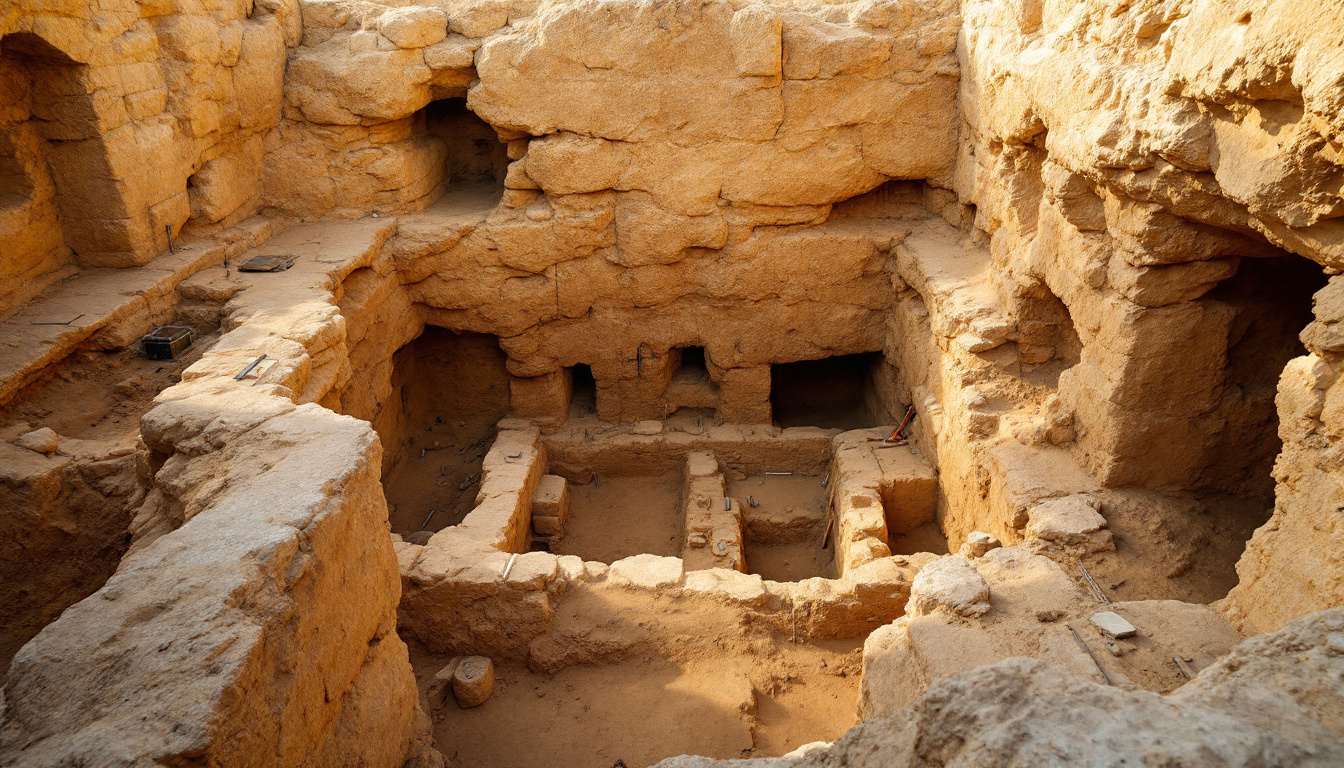
Nearly twenty feet below the stone floor of Jerusalem's Church of the Holy Sepulchre, archaeologists pulled olive pits, grape seeds, and ancient pollen out of the dirt. The soil told them what the Gospel of John told everyone else almost two thousand years ago — there was a garden here, right next to a tomb, right outside the city walls.
The excavation, led by Francesca Romana Stasolla of Rome's Sapienza University, has been running since 2022 and just published its findings in the archaeological journal Liber Annuus. What her team documented beneath that church floor is a landscape that lines up, detail for detail, with the New Testament's account of where Jesus was buried.
John 19:41 describes a garden with a new, unused tomb at the crucifixion site. Matthew, Mark, and Luke describe the tomb as cut directly into rock. Hebrews 13:12 places the site outside the city gate. And John specifically noted that the tomb was close to the garden — close enough to lay a body there before sundown on the Sabbath, which was hours away.
That detail — the proximity — was the whole reason John mentioned the garden at all.
Stasolla's team found grazing land, small cultivated plots, a quarry cut into the hillside, and multiple rock-cut burial chambers. All of them occupy the same patch of ground. All of them positioned just beyond the ancient city walls. The olive pits and grape seeds confirm it — agricultural residue from soil layers that match the period the Gospels describe.
Stasolla was careful with her conclusions. She said her findings don't definitively prove this is where Jesus was buried. But she noted that early Christians' decision to preserve this specific tomb "hints that the memory of where Jesus was buried might have survived the centuries."
That's an archaeologist's way of saying the tradition wasn't invented — it was inherited.
"Archaeology undoubtedly attests to the enduring nature of this commemorative tradition," Stasolla said.
The history of the site tells its own story. Emperor Hadrian built a Roman structure directly over the burial chamber — which, whether he intended it or not, sealed and preserved the tomb beneath it for centuries. Then in the fourth century, Constantine's builders tore Hadrian's structure down, excavated the tomb, separated it from the surrounding graves, and built Christianity's first shrine: an open-air rotunda with twelve columns.
That shrine has been venerated for nearly 1,700 years. The ground beneath it is now confirming what the people who built it apparently already knew.
Some scholars still argue the nearby Garden Tomb is the more credible candidate. That debate isn't going away. But the Garden Tomb doesn't have nearly twenty feet of corroborating soil under it, and it doesn't have a chain of preservation stretching from the first Christians through a Roman emperor's construction project through Constantine's demolition crew to the present day.
What makes this finding land isn't any single detail. It's the convergence: garden, tomb, rock-cut chambers, outside the walls, confirmed agricultural use, a proximity specifically noted in the text of John — all of it at the same coordinates.
Faith and archaeology don't always agree on the terms of the conversation. But every now and then, the shovel hits something that makes the argument a lot shorter.