
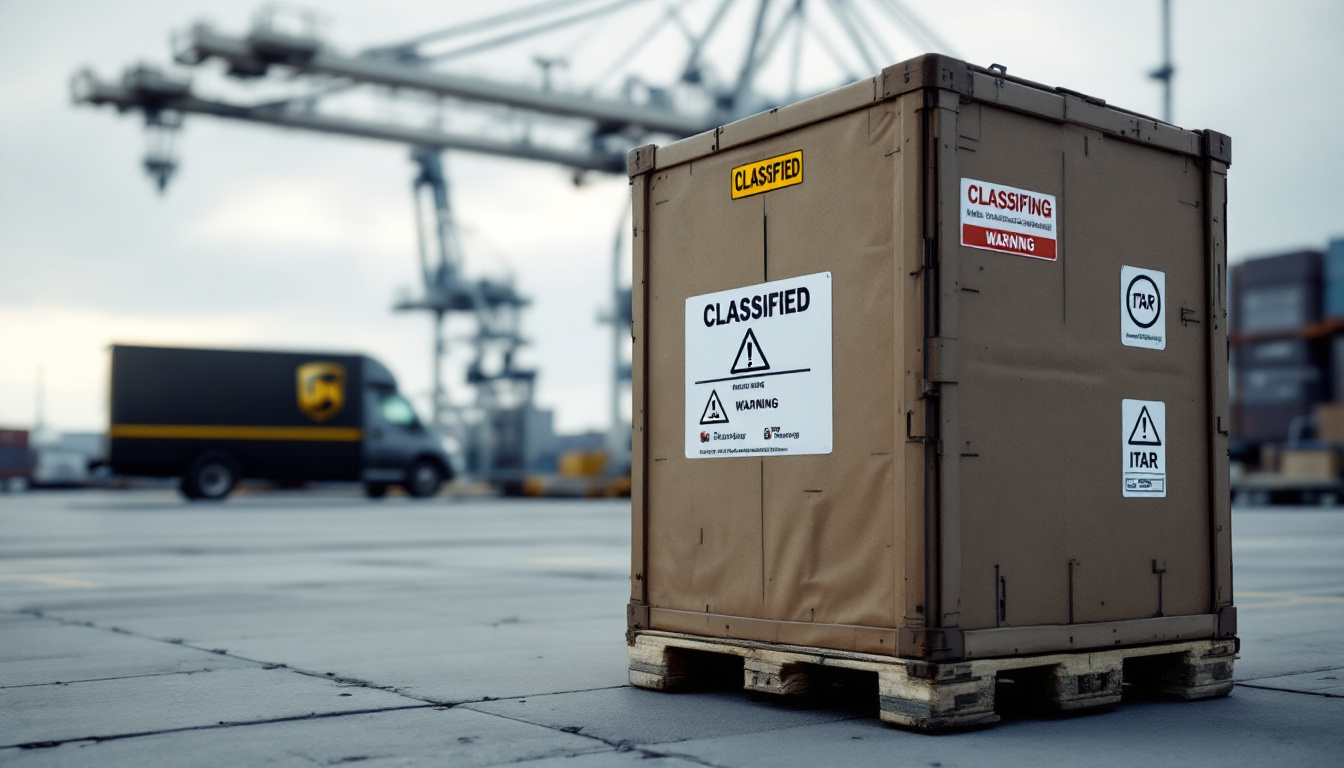
The cockpit canopy and weapons-bay door of an F-35 stealth fighter — both coated in classified radar-absorbing material — were supposed to fly from Australia to San Francisco through South Korea and Taiwan. Instead, they went through Hong Kong. Then Beijing.
Because a UPS logistics worker missed an email.
The freight forwarder DSV, working on behalf of Lockheed Martin, sent an ITAR-compliant warning email explicitly flagging that the shipment must not be routed through Hong Kong. According to Bloomberg, which broke the radar-absorbing material detail on September 23, the email "may have been sent through a different IT system than the one used by the UPS agent." So the agent never saw it. The shipment left Australia late in May 2026, got rerouted through Hong Kong to save a few days of transit time, and landed in Chinese hands.
Washington was briefed on the diversion in June. The State Department's Directorate of Defense Trade Controls opened an investigation. The Pentagon says it is "actively working" to retrieve the components. That was four months ago.
Diana Maurer, who oversees F-35 support reviews at the Government Accountability Office, didn't sugarcoat it. "I'm sure the Chinese celebrated and then they got busy trying to reverse engineer it," she told Bloomberg.
The weapons-bay door isn't some bolt you lose under a workbench. It's a large moving panel engineered to seal flush with the fuselage and open in flight — coated in the same radar-absorbing material that makes the F-35 invisible to enemy air defenses. That coating is the stealth. Without it, you have a very expensive, very visible airplane.
Senator Kevin Cramer, Republican of North Dakota and chair of the Armed Services panel, asked the obvious question: "Did China have a plan all along to intercept this?" Senator Elissa Slotkin went further: "The Chinese are holding some of our most sensitive technology, and we are rolling out the red carpet."
Australia's defense minister Richard Marles tried to wave it off. "We're not talking about sensitive equipment here or sensitive parts," he said. Radar-absorbing stealth coating on the world's most advanced fighter jet. Not sensitive.
Lockheed Martin issued a statement noting that "our logistics decisions are not made unilaterally" — which is corporate for "blame UPS." UPS stock barely moved, dipping less than 1%. The market apparently prices in the occasional delivery of classified military technology to America's chief geopolitical rival.
Here's the part that makes the email mishap feel less like a one-off and more like a symptom. The GAO has tracked over one million spare parts lost by a single F-35 prime contractor since May 2018. Total value: $85 million. The F-35 program office reviewed just 2% of those losses. Ninety-eight percent of missing parts — including, apparently, stealth-coated airframe components — got a shrug.
Politico first broke the story on September 18. Bloomberg added the radar-absorbing material details on September 23. Pentagon officials briefed the House Foreign Affairs and Armed Services Committees on September 29. And on October 7, Bloomberg published the full picture: the email, the routing, the coating, the Chinese celebration.
Meanwhile, on September 17, the State Department approved a possible $24.3 billion F-35 sale to Saudi Arabia, expanding the jet's footprint to 19 partner nations. The sales pitch presumably does not include a footnote about the stealth coating currently sitting in a Chinese lab.
The Pentagon spent decades and hundreds of billions developing radar-absorbing material that makes the F-35 the most survivable fighter in any theater. DSV sent a warning email. It went to the wrong inbox. The parts went to Hong Kong. Then Beijing.
Two percent.