
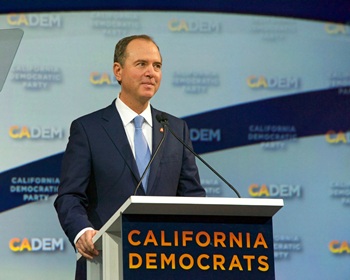
California Senator Adam Schiff stood in the Rose Garden on September 2nd and said the following words out loud: "I am in strong agreement with the President. Congress should immediately take up and pass a federal film tax incentive to bring back these good-paying jobs that we've lost to other countries. Let's work together — Republicans and Democrats — to get this done."
That's Adam Schiff. The impeachment guy. Agreeing with Donald Trump. On camera.
President Trump announced a proposed framework for a 20 percent federal credit on qualifying labor costs for film and television productions — a move designed to drag Hollywood jobs back from foreign countries that have been eating America's lunch on production spending for years. Thirty-eight states already operate their own production-credit programs, but the federal piece has been missing. Trump called the current state of the industry a "complete and total disaster" and proposed fixing it the way he fixes most things: by making it financially stupid not to do business in America.
The coalition behind this thing reads like a guest list from a dinner party that should never exist. Actor Jon Voight was there advocating for the incentive. SAG-AFTRA President Sean Astin was on board, representing roughly 160,000 performers and media professionals. The Directors Guild of America signed on. IATSE — representing over 170,000 technicians, artisans, and craftspeople — was in. SP Media Group CEO Steven Paul and President Scott Karol showed up. The Motion Picture Association threw its weight behind it.
And then there was Schiff.
SAG-AFTRA National Executive Director Duncan Crabtree-Ireland joined Astin in backing the plan, which tells you this isn't some symbolic gesture. The unions did the math. Their members need work. The work has been leaving. Trump offered a solution that puts money in their pockets, and suddenly the partisan math doesn't add up the way it used to.
What makes this moment genuinely significant isn't that Hollywood executives like money — we knew that. It's that the Trump economic model has gotten so results-oriented that his political enemies have to either get on board or explain to their own voters why they'd rather lose jobs than work with the president. Schiff chose door number one. His quote wasn't hedged. It wasn't qualified. It was "strong agreement."
That's what happens when you build policy around jobs instead of ideology. The 20 percent credit framework isn't partisan. It's math. And math has a way of making people forget which team they're supposed to be on.
Schiff spent years trying to remove Trump from office. Now he's asking Congress to pass Trump's plan. What a world. The announcement drew support from virtually every major entertainment industry organization and both sides of the aisle.
Some guys build coalitions by making speeches. Some build them by making the alternative more expensive than the partnership.